Language


Views: 231 Author: Yinda Powder Coating Publish Time: 2026-11-13 Origin: Site


Content Menu
● How Does the Vinyl Dip Coating Process Work?
>> 1. Prepare the Metal and Define Uncoated Areas
>> 2. Preheat and Immerse the Component
>> 3. Withdraw, Fuse, and Cool
>> 4. Inspect the Finished Part
● Which Products Benefit from Vinyl Dip Coating?
● Benefits and Limitations of PVC Dip Coating
>> Where Vinyl Dip Coating Adds Value
● Vinyl Dip Coating vs. Powder Coating: Which Should You Choose?
● Three Specification Checks That Prevent Expensive Rework
>> Check 1: Calculate Coating Build Before Approving the Drawing
>> Check 2: Test the Real Part, Not Only a Flat Coupon
>> Check 3: Define Failure Before Testing Begins
● Safety, Compliance, and Environmental Claims to Verify
>> Food-Contact and Medical Applications
>> Environmental and Energy Claims
● What to Include in a Coating Supplier Inquiry
● Discuss Your Powder Coating Requirements with Yinda Technology
>> Is Vinyl Dip Coating the Same as Powder Coating?
>> Is Vinyl Dip Coating Waterproof?
>> How Thick Can PVC Dip Coating Be?
>> Can Vinyl Dip Coating Be Used Outdoors?
>> Is Vinyl Dip Coating Suitable for Medical Equipment?
>> When Should I Choose Powder Coating Instead?
Vinyl dip coating creates a flexible protective layer on metal parts by immersing them in liquid PVC plastisol and heating the deposited material until it fuses. For manufacturers seeking better grip, cushioning, or surface protection, it can be a practical option. However, it is not interchangeable with powder coating, and its suitability depends on the formulation, component design, and operating environment.
At Yinda Technology, our focus is powder coatings and environmentally oriented materials. Our approach to coating selection starts with the application rather than a preferred finish: identify what the surface must withstand, then compare qualified systems. This guide explains where PVC dip coating fits—and where another finish deserves consideration.
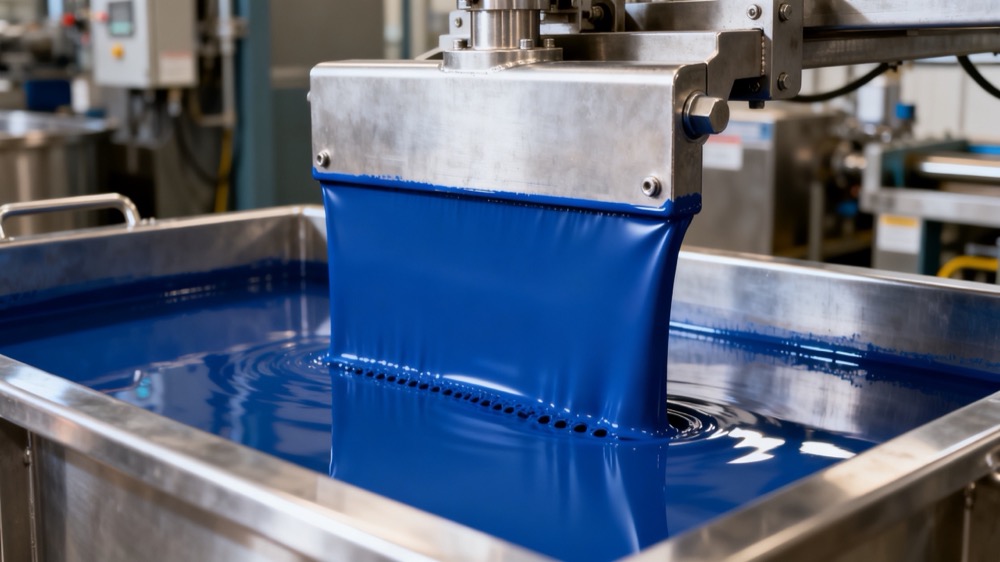
Vinyl dip coating, also called PVC dip coating or plastisol dip coating, applies a flexible vinyl layer to a component. Plastisol is a liquid dispersion of fine PVC resin particles in plasticizers, with stabilizers, pigments, and other additives selected for the application.
An important distinction: the coating bath is already liquid before the part enters it. Conventional plastisol dip coating is not the same as dipping a component into dry powder.
Heat initially causes gelation around the heated substrate. Subsequent heating completes fusion and develops the coating's intended properties. Although processors often use the word "curing," PVC plastisol fusion differs from the chemical crosslinking of conventional thermoset powder coatings.
The finished surface can feel rubber-like, but the underlying material is flexible PVC, not necessarily rubber.
A reliable result requires more than immersion. Surface preparation, thermal control, and component orientation all influence performance.
Remove oil, rust, and contamination. Address sharp burrs before coating, and apply a compatible primer when required by the specified system.
Mask threads, grounding points, mating surfaces, and other areas that must remain exposed. A thick coating may soften the appearance of minor irregularities, but it does not replace proper metal preparation.
Preheat the part according to the material supplier's processing guidance. Immerse it at a controlled speed and maintain the specified dwell time.
Metal temperature, thermal mass, and immersion time influence deposited thickness. Parts containing both heavy sections and thin wire may not build coating uniformly under one processing recipe.
Controlled withdrawal and suitable orientation help manage drainage and pooling. The coated part then receives the heat needed to complete fusion before cooling and finishing.
Do not copy another processor's oven settings without validation. Actual part temperature, coating thickness, and formulation determine the appropriate processing window.
Check appearance, coverage, thickness, adhesion, and dimensional fit. Where the application requires it, include electrical, chemical-resistance, or corrosion testing against agreed acceptance criteria.
A visually smooth sample is only the starting point for qualification.
PVC plastisol coating is particularly useful when the surface must cushion contact, improve handling, or protect another object from scratches.
| Product category | Potential benefit | Essential qualification question |
|---|---|---|
| Tool handles and grips | Softer handling and surface texture | Does grip remain acceptable when wet or oily? |
| Wire racks and baskets | Cushioned contact and component protection | Will the finish withstand the actual wash cycle? |
| Clamps and support brackets | Reduced scratching of supported parts | Does sustained loading damage the coating? |
| Outdoor furniture components | Softer contact and decorative protection | Is the formulation qualified for weather exposure? |
| Selected automotive hardware | Cushioning and protective coverage | Is it compatible with heat, fluids, and assembly tolerances? |
| Medical equipment accessories | Protective touch surfaces | What cleaning and patient-contact requirements apply? |
Application labels alone are insufficient. A storage basket, dishwasher rack, and hot-oil fryer basket experience very different conditions. Never treat them as equivalent coating applications.
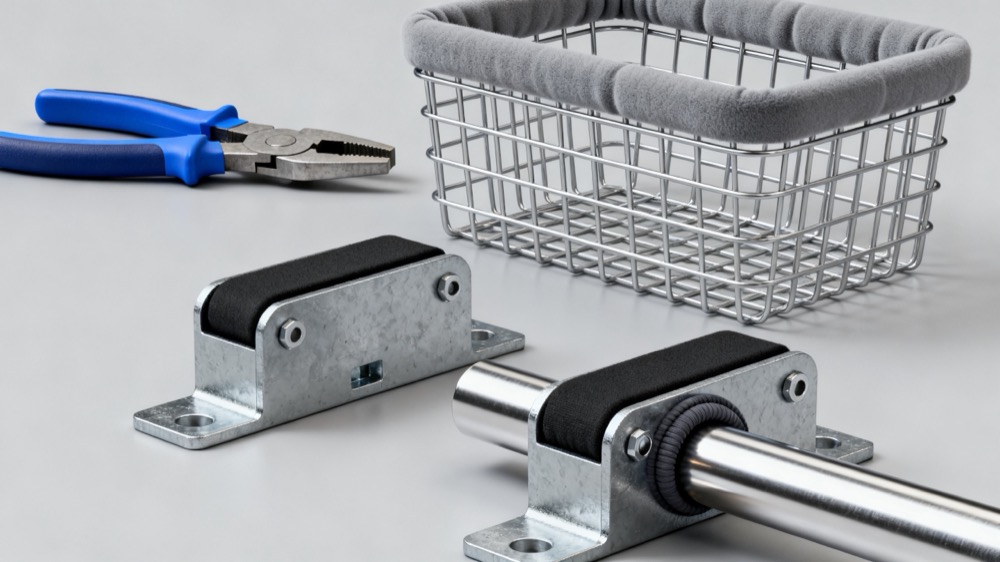
A flexible layer can improve comfort and reduce direct metal-to-metal contact. Partial dipping also allows manufacturers to coat selected sections, such as the gripping area of a handle.
Additional potential advantages include:
- Color identification for tools or product families.
- Cushioning around contact points.
- Coverage of suitably designed three-dimensional parts.
- A moisture barrier when coverage and adhesion remain intact.
- Adjustable thickness and hardness within the selected system's capabilities.
These are design possibilities, not automatic properties of every plastisol formulation.
Damage, pinholes, exposed edges, or poor adhesion can undermine barrier protection. Water resistance should not be confused with a guarantee against underfilm corrosion.
Outdoor durability, chemical resistance, flexibility at low temperatures, and heat resistance vary by formulation. Request relevant test results rather than relying on "heavy-duty vinyl" descriptions.
Likewise, flame resistance and electrical insulation require application-specific verification. A coated handle is not automatically a certified insulated tool, and a PVC coating is not automatically suitable for every fire-performance requirement.
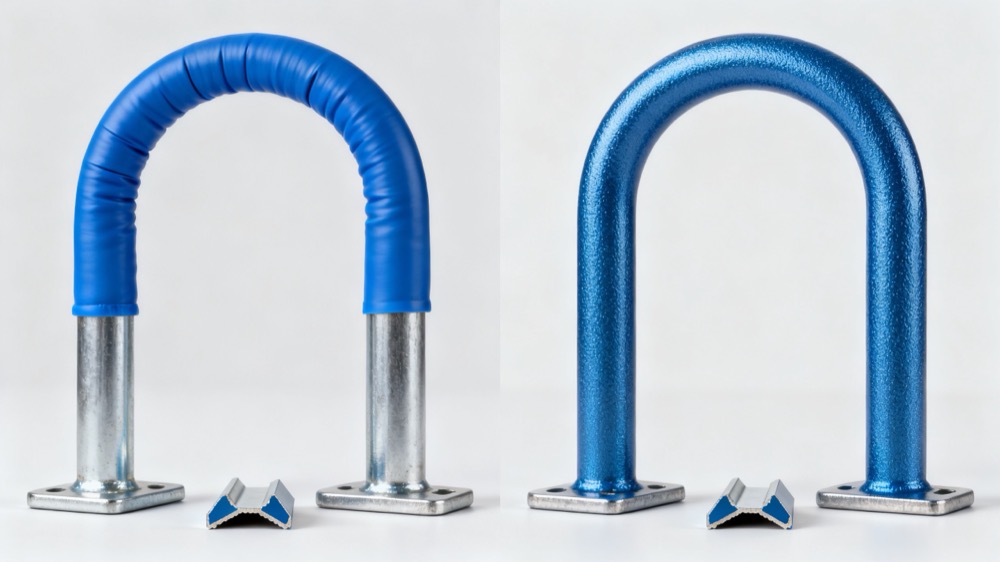
The useful comparison is between defined coating systems, not broad marketing categories. Here, "powder coating" refers primarily to common electrostatically applied thermoset systems; other powder technologies also exist.
| Selection factor | Vinyl plastisol dip coating | Conventional thermoset powder coating |
|---|---|---|
| Application material | Liquid PVC dispersion | Dry polymer-based powder |
| Film development | Heat-driven gelation and fusion | Melting, flow, and chemical crosslinking |
| Typical design priority | Flexible coverage, grip, cushioning | Decorative and protective finished surfaces |
| Dimensional planning | Account for substantial build where specified | Specify film thickness around fits and edges |
| Outdoor selection | Requires a weather-qualified formulation | Requires a suitable exterior-grade chemistry |
| Key process controls | Preheat, bath condition, dwell, fusion | Pretreatment, deposition, part temperature, cure |
For architectural profiles, doors, windows, and appliance housings, evaluate powder coating systems against the relevant appearance and exposure requirements. For a bracket that must cradle a delicate component, flexible dip coating may be more relevant.
Some assemblies benefit from different finishes on different components. There is no requirement to force one coating technology across the entire product.
Suppose a cylindrical handle is 20 mm in diameter and the specified coating is 1 mm thick on each side. Its finished diameter becomes approximately 22 mm.
For an internally coated opening, the same build reduces the available diameter by approximately 2 mm. These are illustrative dimensions, not recommended coating specifications.
Define the finished dimensions and thickness tolerance together. Identify where thickness will be measured, especially around tips, bends, and drainage points.
A flat test panel cannot reproduce every risk associated with welded wire intersections, blind features, sharp transitions, or variable thermal mass.
Ask the processor to coat representative production parts. Inspect difficult locations, then assess fit and performance after the relevant loading, cleaning, or exposure cycle.
For example, a rack may look acceptable before assembly but fail a fit check once coating build narrows its locating features. Discovering that during sampling is cheaper than discovering it after shipment.
"Passes corrosion testing" is incomplete unless the quotation identifies the substrate, preparation, coating system, exposure method, duration, and evaluation criteria.
ASTM B117 describes salt-spray exposure conditions. It does not establish one universal passing result or a conversion from test hours to outdoor service years.
Specify acceptable blistering, rusting, adhesion loss, and other relevant outcomes. Where appropriate, combine laboratory screening with field experience or additional exposure testing.
For food-contact products, verify the exact formulation and intended conditions of use. Compliance for one food type or temperature does not establish suitability for every kitchen application.
In particular, do not approve ordinary PVC plastisol for hot-oil immersion simply because a general application list mentions fryer baskets. Require documented suitability for the actual exposure.
Medical equipment requires similarly careful distinctions. A non-patient-contact equipment frame differs from a component that directly contacts the body. Biological evaluation considers the finished device, its contact conditions, manufacturing processes, and relevant residues—not just the raw material name.
Avoid assuming that all vinyl dip coatings are environmentally preferable. Evaluate the formulation, processing emissions, restricted substances, energy demand, and available end-of-life routes.
Powder coating also needs a specific assessment. Processing efficiency depends on the production line, oven loading, recovery arrangements, and cure requirements. A responsible comparison uses evidence from the proposed process rather than unsupported "green" claims.
A complete inquiry helps suppliers identify limitations early and quote comparable work.
Provide:
1. Substrate material, drawings, and representative photographs.
2. Required coated areas, masking boundaries, and finished dimensions.
3. Indoor or outdoor exposure and expected temperature conditions.
4. Contact with water, chemicals, cleaners, food, or the human body.
5. Target color, texture, thickness, and functional requirements.
6. Test methods, acceptance criteria, annual volume, and batch size.
7. Required technical documents and traceability records.
Request sample approval before production release. Where possible, retain an agreed reference sample and document the approved material and processing requirements.
Yinda Technology researches, manufactures, and supplies powder coatings and environmentally oriented materials, with subsidiaries in China, Indonesia, and Saudi Arabia. Our markets include architectural profiles, doors and windows, new energy vehicles, medical equipment, hardware, and appliances.
If your comparison points toward powder coating, send Yinda Technology your substrate details, drawings, exposure conditions, and target finish. Request a discussion of suitable powder coating options and a sample-validation plan before committing to production.
This inquiry concerns our powder coating capabilities; it does not imply that we provide PVC dip-coating services.
No. Conventional vinyl dip coating uses liquid PVC plastisol. Common thermoset powder coating uses dry powder that melts and chemically crosslinks during heating. Both need controlled processing, but their materials and film-development mechanisms differ.
An intact coating can provide a water-resistant barrier. However, defects, damage, exposed edges, and adhesion problems can allow moisture to reach the substrate. Evaluate the complete coated component under its intended exposure conditions.
Achievable thickness depends on the formulation, part geometry, thermal mass, and processing conditions. Ask the processor for a validated range and tolerance for your component rather than specifying a universal thickness from an unrelated example.
Yes, when a suitable formulation and complete coating system are qualified for the exposure. Ask for evidence addressing weathering, temperature cycling, color retention, and corrosion protection relevant to the installation.
Potentially, but suitability depends on the component's role, cleaning requirements, and body-contact conditions. A general material description does not establish biological safety or compatibility with repeated disinfection.
Consider powder coating when the application calls for a decorative protective finish rather than a thick, cushioned grip. Select the chemistry, preparation, film thickness, and qualification tests around the actual substrate and service environment.
1. Precision Coating Technology & Manufacturing. "What Is Vinyl Dip Coating, and What Items May Benefit from It?" Original article used as the starting point for restructuring and identifying claims requiring qualification. Its broad performance and application claims are not adopted without qualification. [precisioncoatingtech]
2. The Chemical Company. "What Are Plastisol Plasticizers?" Technical explanation of PVC dispersions, plasticizer functions, gelation, fusion, and formulation-dependent processing behavior. [thechemco]
3. Innovative Coatings. "PVC Plastisol Dip Coating." Industrial processor guidance covering fixturing, primer use, immersion, and the relationship between substrate properties, processing conditions, and coating thickness. [innovativecoatings]
4. Precision Dip Coating. "Plastisol Dip Coating for Manufacturing: Process, Capabilities, and Production Benefits." Process information covering preparation, preheating, immersion, withdrawal, fusion, and inspection. [precisiondipcoating]
5. Powder Coating Institute. "What Is Powder Coating?" Industry explanation of powder coating composition, electrostatic spray deposition, and heat-driven crosslinking in conventional thermoset systems. [powdercoating]
6. ASTM International. "B117: Standard Practice for Operating Salt Spray (Fog) Apparatus." The linked edition supports the discussion of test scope and limitations when extrapolating laboratory exposure to natural environments; procurement specifications should identify the applicable edition. [astm]
7. U.S. Food and Drug Administration. "Determining the Regulatory Status of Components of a Food Contact Material." Guidance on component authorization, specifications, and limitations associated with intended conditions of use. [fda]
8. U.S. Food and Drug Administration. "Basics of Biocompatibility: Information Needed for Assessment by the FDA." Guidance explaining finished-device assessment, body-contact conditions, manufacturing processes, and residuals. [fda]


