Language


Views: 231 Author: Yinda Powder Coating Publish Time: 2026-11-06 Origin: Site


Content Menu
● How Does Fluidized Bed Powder Coating Work?
● Fluidized Bed Powder Coating Process: Step by Step
>> 1. Clean and Prepare the Substrate
>> 3. Immerse the Part in the Fluidized Powder
● Which Powders Are Used for Fluidized Bed Coating?
● Fluidized Bed Coating Temperature and Thickness: A Documented Example
● Fluidized Bed Coating vs. Electrostatic Powder Coating
● Three Design Checks Before Choosing Fluidized Bed Dipping
>> Check 1: Can the Component Retain Enough Heat?
>> Check 2: Will Coating Buildup Affect Assembly?
>> Check 3: Can Powder Reach and Leave the Required Areas?
● Troubleshooting Common Fluidized Bed Coating Defects
● Environmental Benefits, Energy Use, and Safe Operation
● How to Specify a Fluidized Bed Powder Coating Project
● Discuss Your Coating Requirements with Yinda Technology
>> Is fluidized bed powder coating the same as electrostatic coating?
>> How thick is fluidized bed powder coating?
>> Does fluidized bed powder coating require curing?
>> Can fluidized bed coating cover complex components?
>> Can ordinary spray powder be used in a fluidized bed?
>> Is fluidized bed powder coating suitable for medical equipment?
Fluidized bed powder coating protects preheated components by dipping them into a bed of powder suspended by upward-flowing air. Powder melts against the hot surface, forming a protective film. For manufacturers seeking corrosion resistance, impact protection, electrical insulation, or a comfortable grip, this process deserves consideration.
However, thicker does not automatically mean better. A successful coating must match the substrate, component geometry, service environment, and dimensional tolerances.
At Yinda Technology, our focus spans powder coatings, environmentally responsible materials, and energy-saving technology promotion. From a materials-selection perspective, the starting question is straightforward: what must the finished component withstand, and how will that performance be verified?
This guide explains the fluidized bed coating process, its limitations, and the questions worth asking before production.

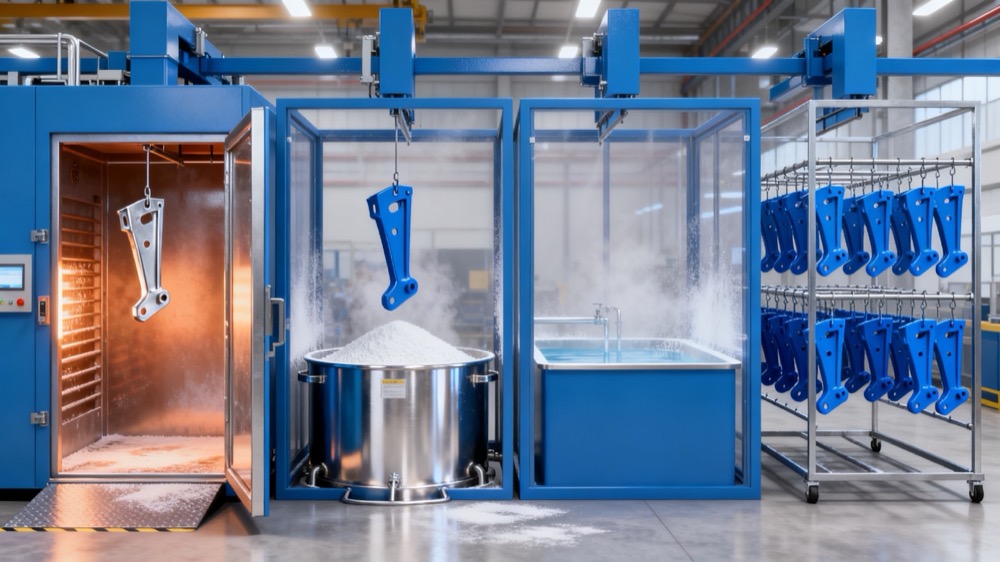
A fluidized bed contains powder above a porous distribution plate. Air passes upward through the plate, separating and suspending the particles so the powder behaves somewhat like a liquid.
A preheated component enters this moving powder bed. Its stored heat melts particles touching the surface, building a continuous coating.
Conventional fluidized bed dipping relies primarily on heat rather than electrostatic attraction. This distinguishes it from electrostatic powder spraying and from electrostatic fluidized bed systems.
The practical implication is important: coating performance depends on more than the powder itself. Metal thickness, temperature distribution, transfer time, immersion duration, and part orientation all influence the result.
Immersion also does not guarantee identical thickness everywhere. Thin sections lose heat faster, while heavy sections retain more energy and may accumulate additional material.
Remove oil, grease, oxide, welding residue, and other contamination before coating.
Depending on the substrate and coating specification, preparation may include abrasive blasting, chemical pretreatment, or a compatible primer. Some formulations are designed for primer-free application under specified conditions.
Do not interpret "primer-free" as "preparation-free." Adhesion still depends on an appropriately prepared surface.
Inspect welds, burrs, sharp edges, and areas that can trap cleaning chemicals. Problems hidden beneath a thick coating can still cause premature failure.
Heat the component according to the selected powder's technical data sheet.
The key measurement is actual metal temperature, not simply the oven setting. Two components in the same oven can reach different temperatures because their mass, wall thickness, and geometry differ.
Transfer time matters too. A thin wire component may cool substantially before reaching the bed.
Establish a repeatable heating and transfer procedure before adjusting immersion time to compensate for inconsistent temperatures.
Lower the hot component into a stable, evenly fluidized bed.
Control the immersion depth, orientation, movement, and dwell time. Gentle movement may help powder reach accessible surfaces and prevent localized buildup.
Airflow must support consistent fluidization without unnecessarily carrying powder out of the tank. Channeling or uneven movement can produce inconsistent deposition.
Parts with blind cavities, close gaps, or difficult internal passages require particular attention during trials.
Some components retain enough heat to produce a satisfactory film after dipping. Others require additional heating to complete melting and improve flow.
For thermoplastic coatings, this stage is fusion rather than chemical curing. Thermosetting powders require the specified chemical cure.
There is no universal rule that every coating needs post-heating or that every post-heating oven must operate below a fixed temperature. Follow the formulation-specific processing instructions.
Cool the component using the approved procedure, then check film thickness, appearance, adhesion, and critical dimensions.
For barrier or electrical applications, additional discontinuity or dielectric testing may be necessary.
A smooth surface is useful evidence of appearance, but it does not independently prove corrosion resistance, insulation performance, or service life.
Thermoplastic powders are widely associated with fluidized bed dipping. Common examples include polyethylene, polyamide or nylon, and PVC. Specialized thermoplastic formulations offer additional combinations of adhesion, flexibility, and barrier performance.
Material selection should begin with operating conditions rather than color alone.
| Selection factor | Question to resolve |
|---|---|
| Mechanical exposure | Will the part experience impact, abrasion, bending, or repeated handling? |
| Chemical contact | Which chemicals, concentrations, and temperatures are involved? |
| Outdoor exposure | What weathering and ultraviolet resistance are required? |
| Electrical function | What dielectric performance and thickness must be verified? |
| Regulatory requirements | Does the exact grade need approval for a particular contact application? |
| Dimensional limits | How much coating can mating surfaces and clearances accommodate? |
Avoid transferring claims from one resin family to every grade within it. Formulation, pretreatment, film thickness, and processing conditions influence performance.
Medical equipment, drinking-water components, and electrical assemblies need application-specific assessment. A general description such as "durable thermoplastic" is not evidence of suitability.
Published technical data illustrates why universal processing recipes are unreliable.
For example, the Abcite 500 technical guide recommends substrate preheating between 180°C and 260°C, depending on geometry. It gives an immersion range of approximately 2–10 seconds, depending on the required thickness.
The same guide advises against films below 250 micrometers for less aggressive environments and recommends at least 400 micrometers where severe abrasion or impact may occur.
These figures describe one commercial product, not every fluidized bed powder.
| Published example | Product-specific guidance |
|---|---|
| Material | Abcite 500 thermoplastic powder |
| Recommended substrate preheating | 180–260°C, depending on geometry |
| Immersion time | Approximately 2–10 seconds |
| Lower film-thickness guidance | Not below 250 µm for less aggressive environments |
| Severe abrasion or impact exposure | At least 400 µm advised |
For purchasing and production teams, the lesson is to request grade-specific processing data.
Do not copy these settings into another formulation's production instructions. Confirm the current technical data sheet and validate the complete coating system on representative components.
Both processes apply dry powder, but they address different manufacturing priorities.
| Consideration | Conventional fluidized bed dipping | Electrostatic powder spraying |
|---|---|---|
| Deposition mechanism | Powder melts against a preheated component | Charged powder deposits on a suitably grounded component |
| Typical objective | Substantial protective or functional film | Controlled decorative or protective finish |
| Heat sequence | Component is heated before immersion | Powder is commonly deposited before oven curing |
| Main design concern | Heat retention, immersion access, and dimensional buildup | Electrostatic access, grounding, and deposition consistency |
| Selection priority | Barrier thickness and functional performance | Appearance, film control, and production flexibility |
Neither method is automatically superior.
For architectural profiles and door or window components, begin with appearance, weathering requirements, and finished dimensions. For a protective handle or impact-exposed bracket, a thicker thermoplastic film may justify evaluation.
Likewise, new-energy vehicle components should not be treated as one application. Decorative housings, insulating parts, and mechanically exposed brackets can require very different coating systems.
Thin sections can cool before sufficient powder melts. Heavy sections may build more film than nearby lightweight features.
Evaluate the complete component, not only a flat test panel.
A successful laboratory coupon does not automatically establish a production window for a welded assembly with mixed wall thicknesses.
Review threads, holes, slots, bearing seats, grounding points, and mating surfaces before coating.
A thick film can interfere with assembly or obscure identification marks. Masking may be necessary, and drawings should distinguish coated dimensions from bare-metal dimensions.
Agree on acceptable buildup before tooling or production fixtures are finalized.
Immersion provides broad access, but trapped air and restricted passages can still create coverage problems.
Review blind holes, narrow gaps, internal corners, and withdrawal orientation.
Where access is uncertain, inspect sectioned trial parts or use another suitable verification method rather than assuming that external appearance represents internal coverage.
Use a controlled investigation instead of changing several settings simultaneously.
| Observed defect | Possible contributors | First checks |
|---|---|---|
| Thin or incomplete coverage | Insufficient metal temperature, heat loss, short immersion | Measure part temperature immediately before dipping |
| Excessive buildup | High stored heat or excessive dwell | Compare thickness by location and reduce variability |
| Rough or incompletely fused film | Inadequate fusion, contamination, inconsistent fluidization | Check thermal history and powder condition |
| Pinholes or bubbles | Moisture, substrate outgassing, trapped contamination | Review drying and pretreatment |
| Poor adhesion | Contamination, unsuitable preparation, incompatible process | Verify preparation and material instructions |
| Blocked holes or tight assemblies | Unplanned film buildup | Revisit masking and dimensional allowances |
These are diagnostic starting points, not definitive diagnoses.
Record powder grade, batch, substrate preparation, actual metal temperature, transfer delay, immersion time, and post-heating conditions. Those records make trials reproducible and help separate material issues from process variation.
Dry powder application avoids the solvent carrier used in many liquid coating systems. However, this advantage does not make every powder coating process emission-free, risk-free, or automatically energy-efficient.
Preheating heavy metal components consumes energy. Additional heating, rejects, and rework can increase the energy used per accepted part.
Evaluate environmental performance through measurable operating factors:
- Powder consumption per accepted component.
- Reject and rework rates.
- Oven loading and unnecessary idle time.
- Transfer delays and thermal losses.
- Powder handling and waste management.
Airborne combustible powder can also present fire and explosion hazards. Appropriate ventilation, ignition-source control, housekeeping, and equipment design remain essential.
Avoid cleaning methods that disperse deposited powder into dust clouds. Use the product safety data sheet and applicable local requirements to establish operating procedures.
Before requesting a quotation, prepare a technical brief containing:
1. Substrate alloy, dimensions, wall thickness, and part weight.
2. Drawings showing masked surfaces and dimensional limits.
3. Required film thickness and inspection locations.
4. Expected chemical, outdoor, thermal, and mechanical exposure.
5. Appearance requirements, including color and texture.
6. Required approvals, test methods, and acceptance criteria.
7. Production quantity, batch size, and available equipment.
Then run a representative trial.
Evaluate coating uniformity, assembly fit, adhesion, and application-specific performance before approving production. Agree on what constitutes a pass, who performs testing, and which records accompany supplied material.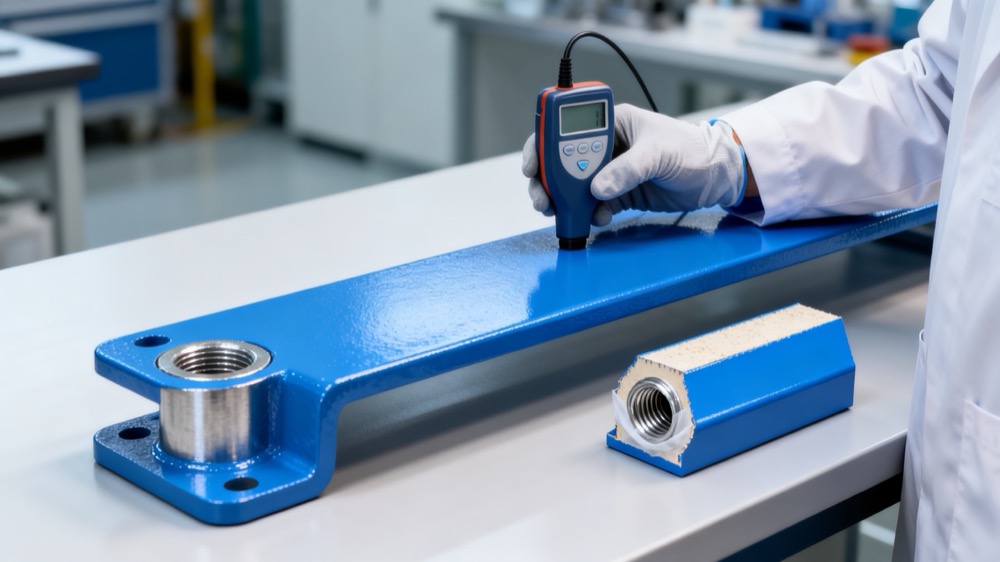
Yinda Technology develops, manufactures, and sells powder coatings and environmental materials, with subsidiaries in China, Indonesia, and Saudi Arabia. Our products serve sectors including architectural profiles, doors and windows, new-energy vehicles, medical equipment, hardware, and appliances.
Planning a fluidized bed coating project? Send Yinda Technology your component drawing, substrate details, target thickness, operating environment, and required tests.
Ask our team to confirm whether a suitable fluidized-bed-compatible grade is available and what trial conditions it requires. Start with material compatibility and measurable acceptance criteria before committing to production.
No. Conventional fluidized bed dipping melts powder onto a preheated component. Electrostatic spraying uses electrical attraction to deposit powder before the specified heating stage.
Thickness depends on the formulation, component temperature, geometry, and immersion time. Specify a validated range rather than assuming one standard thickness applies to every powder.
Thermoplastic coatings melt and solidify without chemical crosslinking. They may require post-heating for fusion. Thermosetting materials require their specified chemical cure.
It can coat many accessible shapes, but narrow gaps, trapped air, blind cavities, and uneven heat retention can affect coverage. Representative trials are essential.
Do not assume interchangeability. Particle characteristics, flow behavior, resin chemistry, and processing requirements must suit the intended application method. Obtain confirmation from the powder supplier.
Potential suitability depends on the exact component, cleaning conditions, contact requirements, and documented material performance. General coating durability does not establish medical suitability.
- Precision Coating Technology & Manufacturing. "Understanding Fluidized Bed Powder Coating and Its Benefits For Your Product." Original article supplied for restructuring; used for the baseline process description and identification of content gaps. [precisioncoatingtech]
- Axalta Coating Systems. "Abcite® 500: Technical Data Sheet / Application Guide." Product-specific preheating, immersion, thickness, and optional post-heating guidance. Published document version: May 2015; confirm current supplier instructions before production. [axalta]
- Axalta Coating Systems. "Abcite® 545: Technical Data Sheet / Application Guide." Supporting information on geometry-dependent preheating and fluidized bed application. Published document version: May 2015. [axalta]
- Occupational Safety and Health Administration. "29 CFR 1910.107—Spray Finishing Using Flammable and Combustible Materials." Definitions covering fluidized powders and requirements addressing powder handling, ventilation, ignition control, and housekeeping. This is a United States reference, not a substitute for local requirements. [osha]
- Occupational Safety and Health Administration. "Technical Manual, Section IV, Chapter 6: Combustible Dusts." Supporting reference for combustible-powder fire and explosion hazards. [osha]


